Did you really ovulate day 14?


Often it is assumed that ovulation happens cycle day 14, but this is based on the assumption that cycles are 28 days and luteal phases are 14 days. In a 2019 large observational study it was shown that the average cycle length was 29.3 days and average luteal phase length was 12.4 days. So its more likely you ovulated day 16 than day 14. Knowing the timing of ovulation can be helpful for family planning (avoiding or achieving pregnancy), tracking cycle symptoms, and calculating estimated due dates.
What is the risk of assuming ovulation is cycle day 14?
For family planning, assuming ovulation occurs cycle day 14 is extremely risky if being used to avoid pregnancy and can lead to extended times to conceive when trying to achieve pregnancy. This is basically a variation of the calendar or rhythm method, which is notoriously ineffective when there is any deviation in the cycle length.
If ovulation occurs later than day 14, it can lead to an incorrect estimated due date and unnecessary interventions. Most calculate estimated due dates from the last menstrual period (LMP), under the assumption that ovulation occurs cycle day 14. This method assumes that gestational age (age from LMP) is equivalent to fetal age (age from conception) plus 14 days. If ovulation occurs on any day except cycle day 14, the gestational age and estimated due date will be incorrect.
When does ovulation actually occur?
In a 2019 large observational study, average ovulation day was cycle day 16.9 with most women ovulating between days 11 and 22. It also showed that the average luteal phase length was 12.4 days, with most luteal phases being 10 to 14.4 days. So even in a 28 day cycle, it would be reasonable for ovulation could occur between cycle day 13 and 18 based on these ranges. So why does ovulation vary so much? Lets break down the menstrual cycle to understand.
First we will define the phases of the cycle.
Menstrual | Follicular | Peak | Luteal |
The menstrual phase is from the first day of continuous flow of blood until the last day or bleeding or spotting where the presence or absence of mucus can be observed.
The follicular phase is from the end of the menstrual phase until peak is identified (sometimes it is also defined to include mensuration). This phase can be broken up into an infertile and fertile window, sometimes called the ovulatory phase. Follicular development and ovulation are a very delicately controlled hormonal feedback loop between the ovaries and brain. Things like stress, illness, or insufficient energy or nutrients can delay follicular development or ovulation. The variation in length each cycle is due to variation in the follicular phase.
Peak can be identified based on mucus symptoms, basal body temperature, urinary hormones, or other biomarkers. Since we cannot pinpoint ovulation without an ultrasound, peak is the day of highest fertility and gives us an idea of around when ovulation happened.
The luteal phase is from the day after peak until the next menstrual period. It is generally very consistent for an individual, only varying by 1-2 days from cycle to cycle. A healthy luteal phase is 10 to 17 days, any shorter and there cannot be implantation, if conception occurs, indicating a hormonal issue.
How do we know when ovulation occurs?
If you use an app to track your period that also tells you when you are ovulating, its likely using a version of the rhythm/calendar method. The app assumes your luteal phase is 14 days (which we know is not the most common length), and subtracts 14 from your average cycle length to get your "ovulation day." This method does not account for any variation in the follicular phase, which can lead to inaccuracy.

During follicular development estrogen rises, peaking shortly before ovulation. Estrogen can be observed either through the changes in cervical mucus, changes in cervical position, or with urinary hormone tests. Around 24-36 hours before ovulation, LH peaks, which can be observed in urinary hormone tests. This LH peak also is what causes mittelschmerz, commonly called ovulation pain. Once ovulation occurs, the egg will die within 12-24 hours if not fertilized. After ovulation occurs the ruptured follicle collapses and forms the corpus luteum which releases progesterone. Progesterone causes a drying effect of discharge, changes in cervical position, and a rise in basal body temperature.
By charting these biomarkers, you can get an accurate assessment of when ovulation occurred, that can be used for family planning or calculating a more accurate due date. If you want to learn more about how to track these signs you can learn more in my course Charted Wisdom. If you are looking for more one on one support, or to learn to avoid pregnancy naturally, you can see all my options for learning fertility awareness methods here.
Summary
Ovulation rarely occurs cycle day 14, and this assumption can lead to issues if using it for family planning or estimated due dates. For family planning it is always better to use real time biomarkers with a modern fertility awareness based method which all have similar efficacy to hormonal birth control. In the case of pregnancy, if ovulation occurred on day 22, using the last menstrual period to calculate estimated due date would be almost a week off. If this is not caught in an early ultrasound it can lead to unnecessary interventions.
1
Searing the Beef
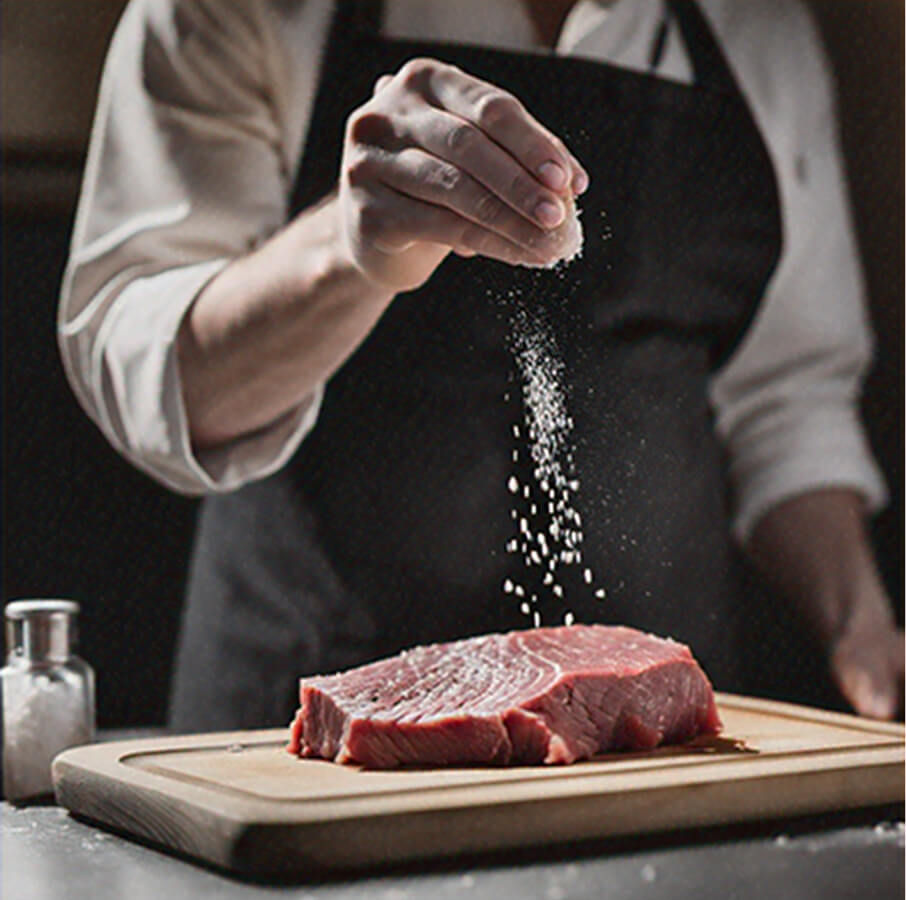
Sear beef fillets on high heat for 2 minutes per side to form a golden crust. Let it cool before proceeding to keep the beef tender.
1
Searing the Beef
Sear beef fillets on high heat for 2 minutes per side to form a golden crust. Let it cool before proceeding to keep the beef tender.
1
Searing the Beef
Sear beef fillets on high heat for 2 minutes per side to form a golden crust. Let it cool before proceeding to keep the beef tender.
1
Searing the Beef
Sear beef fillets on high heat for 2 minutes per side to form a golden crust. Let it cool before proceeding to keep the beef tender.
Notes


1
Season the good fresh beef fillets with salt and black pepper. Heat olive oil in a pan over high heat and sear the fillets for 2 minutes per side until it fully browned. Remove the beef from the pan and brush with a thin layer of mustard. Let it cool.
1
Season the good fresh beef fillets with salt and black pepper. Heat olive oil in a pan over high heat and sear the fillets for 2 minutes per side until it fully browned. Remove the beef from the pan and brush with a thin layer of mustard. Let it cool.
1
Season the good fresh beef fillets with salt and black pepper. Heat olive oil in a pan over high heat and sear the fillets for 2 minutes per side until it fully browned. Remove the beef from the pan and brush with a thin layer of mustard. Let it cool.
1
Season the good fresh beef fillets with salt and black pepper. Heat olive oil in a pan over high heat and sear the fillets for 2 minutes per side until it fully browned. Remove the beef from the pan and brush with a thin layer of mustard. Let it cool.
Instructions
Quality Fresh 2 beef fillets ( approximately 14 ounces each )
Quality Fresh 2 beef fillets ( approximately 14 ounces each )
Quality Fresh 2 beef fillets ( approximately 14 ounces each )
Beef Wellington
Beef Wellington
Fusion Wizard - Rooftop Eatery in Tokyo
Author Name
%20(1).jpg)
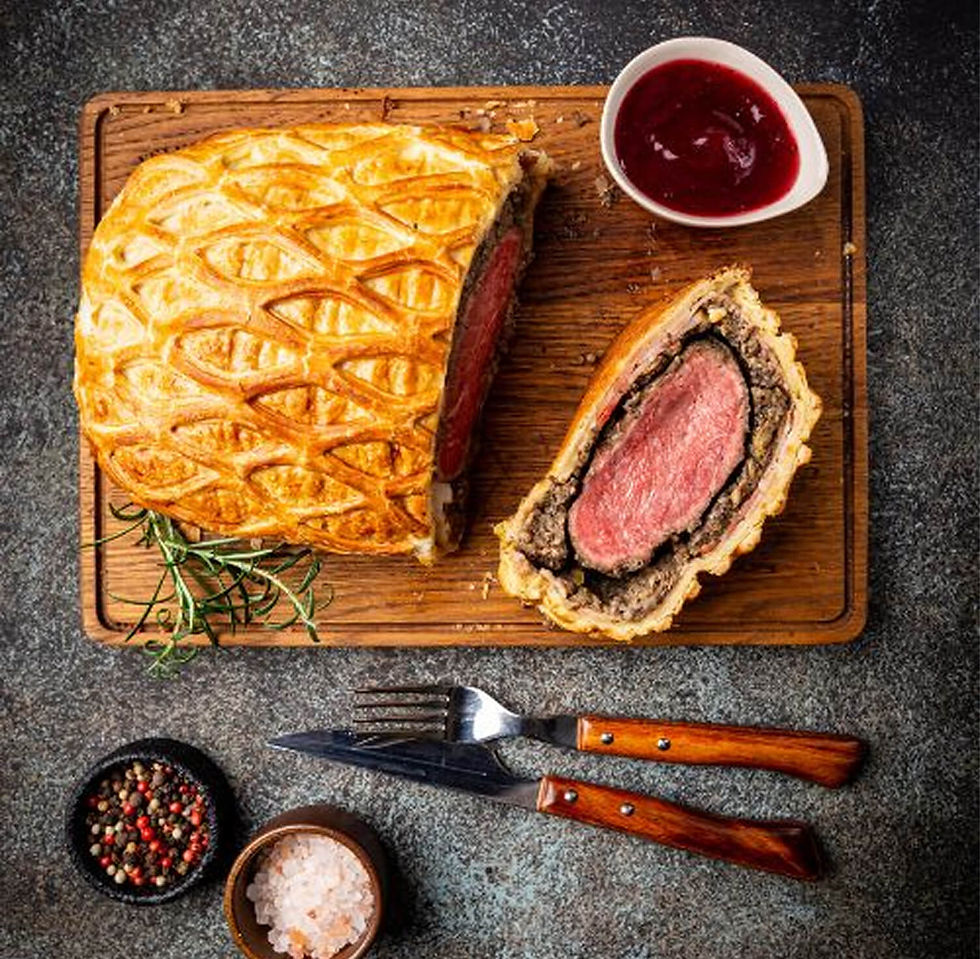
Beef Wellington is a luxurious dish featuring tender beef fillet coated with a flavorful mushroom duxelles and wrapped in a golden, flaky puff pastry. Perfect for special occasions, this recipe combines rich flavors and impressive presentation, making it the ultimate centerpiece for any celebration.
Servings :
4 Servings
Calories:
813 calories / Serve
Prep Time
30 mins
Prep Time
30 mins
Prep Time
30 mins
Prep Time
30 mins


Comments